

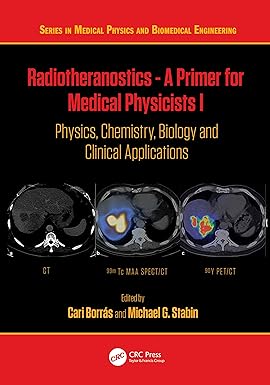
RADIOTHERANOSTICS A PRIMER FOR MEDICAL PHYSICISTS I PHYSICS CHEMISTRY BIOLOGY AND CLINICAL APPLICATIONS (HB 2024)
Paperback
by BORRAS C(Author)
(0
reviews)
Inhouse product
Price
$161.02
/1
• Free Standard Shipping Transit in 8 – 14 Business Days
• Expedited Shipping Transit in 6 – 8 Business Days
Share
Top Selling Products
-
 $21.15
 -
$14.74
-
$10.97
-
$20.71
-
$17.88






Reviews & Ratings
0
out of 5.0
(0
reviews)
There have been no reviews for this product yet.
This initial volume of a two-part series provides a complete overview of the scientific, clinical, and educational aspects of using radiotheranostics to combat cancer. It starts by defining radiotheranostics, outlining the history of radionuclide therapy and theranostics, and explaining the basic biology of cancer. The book examines the clinical uses of simple radionuclides like ¹³¹I and ²²³Ra, as well as the applications of cancer-specific carriers (peptides, small molecules, antibodies, and nanoparticles) that are linked to radionuclides. It also covers clinical trials and drug development, reviews population-based studies, and discusses the potential adverse effects of radionuclide therapy, including radiation injuries and chemical toxicity.
Additionally, this volume details the chemical and physical processes involved in producing radionuclides, explains how radioactivity is measured accurately, and covers important aspects of instrumentation such as calibration, quantitative imaging, and quality assurance. It concludes with guidance on the necessary education, training, and skills for a team working with radiotheranostics. The book also summarizes the main physics characteristics of current theranostic approaches – many of which will be expanded upon in the second volume – and offers a glimpse into future developments. As a foundational text for the more in-depth second volume, this book is a valuable resource for medical and health physicists with a basic understanding of nuclear medicine. Its goal is to inform them and the wider cancer community about how radiotheranostics can improve cancer treatment and increase patient survival times.
Sources and related content
Additional Product Info :
ISBN 10 :
1032138971
1032138971
ISBN 13 :
9781032138978
9781032138978
Publisher :
TAYLOR & FRANCIS
TAYLOR & FRANCIS
Language :
English
English
Dimensions :
7 x 0.56 x 10
7 x 0.56 x 10
Item Weight :
0.66 kg
0.66 kg
Frequently Bought Products
Product Queries (0)
Login Or Registerto submit your questions to seller
Other Questions
No none asked to seller yet
Top Selling Products
-
$21.15
-
$14.74
-
$10.97
-
$20.71
-
$17.88

Arista Kart International, your global gateway to the world of books. With a curated inventory of over 1.5 million titles, we are proud to be one of the largest online bookstores, connecting readers across continents with stories, knowledge, and inspiration.